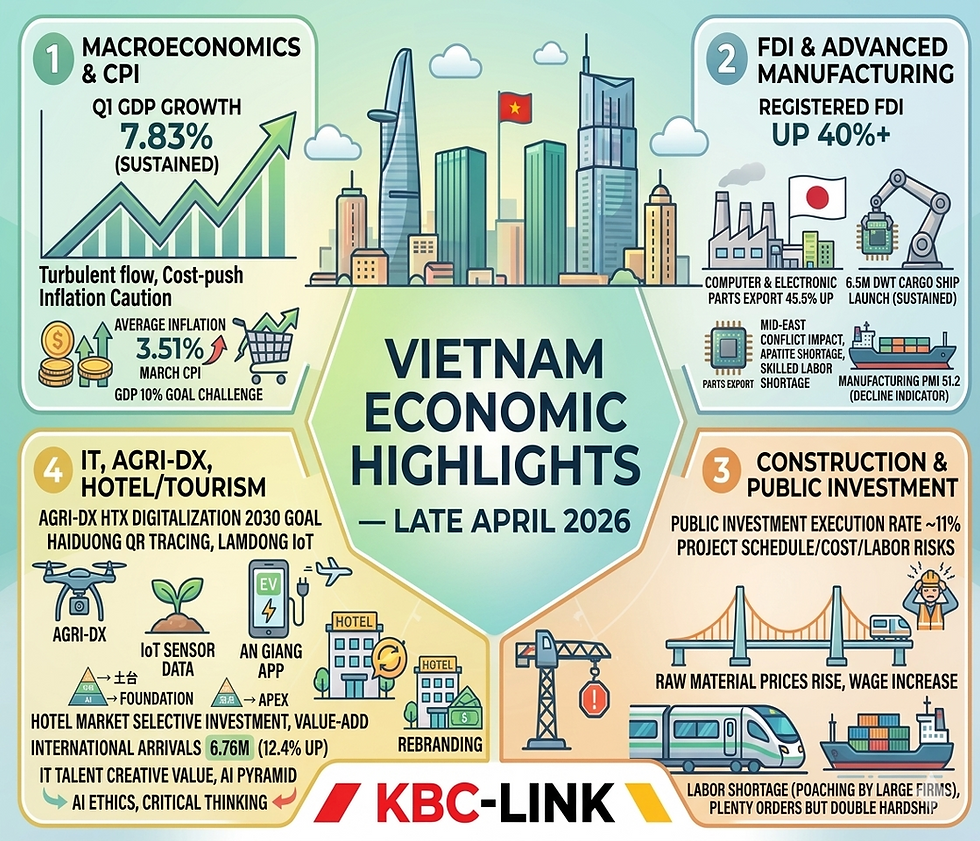
🇻🇳 Vietnam Economic Highlights (Late May 2026) | KBC-LINK
This report curates the most important Vietnam-related economic news from the second half of May 2026, selected specifically for small and mid-sized foreign businesses and investors who are actively monitoring or considering entry into the Vietnamese market.
Note: The blockquote sections at the end of each topic represent KBC-LINK's analysis and commentary based on publicly available information.
Late May Overview
Vietnam's economy — described by the World Bank as "solid" — is sustaining macro-level growth while entering a significant period of structural transformation. In the technology sector, the government has codified its "10 Strategic Technology Groups" covering AI and semiconductors into law, while in agriculture, the country's largest integrated agri-food corporation has launched an AI-driven transformation of its entire value chain. The tourism and hotel industry, which recorded the fastest recovery in the region in Q1, is seeing an acceleration of premium resort investment by global operators.
At the same time, the construction sector — buoyed by record public investment backlogs — is grappling with surging material costs, while manufacturing continues to face supply-side constraints: persistent dependence on Chinese intermediate goods and an underdeveloped local supplier base that complicate the narrative of "China decoupling." Climate risk is also becoming more tangible, with extreme heat triggering widespread forest fire alerts across the country.
For companies operating in or considering Vietnam, the operating environment calls for strategies that capture robust demand while building in cost discipline, supply chain optimization, and climate and disaster risk management.

📌 Also recommended: Vietnam Economic Highlights — Early May 2026
Vietnam Industry Watch: Key Sectors to Watch

1.Vietnam Economy (General)
World Bank Affirms Vietnam's 2026 Outlook as "Solid," Calls for Sustained Structural Reform
The World Bank released its latest Vietnam Economic Update, affirming that Vietnam entered 2026 in the strongest position of any economy in ASEAN, having recorded GDP growth of 8% in 2025 — the fastest in the region. Growth is expected to moderate to a still-high 6.8% in 2026 as Middle East oil price shocks weigh on global demand and domestic activity. (The World Bank's concurrent East Asia and Pacific regional report projects a slightly more conservative 6.3% for Vietnam.)
The primary growth drivers remain strong exports and investment. The government's USD 320 billion public infrastructure investment plan and ongoing administrative rationalization are supporting private consumption and business activity. Inflation is projected to average just above 4% in 2026. The report identifies deepening linkages between foreign-invested and domestic firms, and improving productivity, as the critical medium-term challenges for sustaining momentum.
Source: Vietnam News, May 15, 2026 https://vietnamnews.vn/economy/1781434/viet-nam-s-economic-outlook-in-2026-remains-solid-despite-global-headwinds-wb.html
Vietnam's resilient macroeconomic fundamentals position it as a comparatively lower-risk investment destination in the current global environment. Sectors that stand to benefit directly from the government's infrastructure investment push — logistics, construction, engineering services — remain strategically attractive. That said, the above-4% inflation trajectory signals rising local operating costs that should be factored into business planning from the outset.
2.Construction and Infrastructure
Vietnam Unveils Timeline for USD 67.3 Billion North–South High-Speed Railway; Groundbreaking Targeted for Q4 2026–Q4 2028
The Thang Long Project Management Board under the Ministry of Construction has released the implementation roadmap for Vietnam's landmark North–South High-Speed Railway project. The line will span approximately 1,541 km, connecting Ngoc Hoi Station in Hanoi to Thu Thiem Station in Ho Chi Minh City. The railway will be built as an entirely new double-track electrified line with a standard gauge of 1,435 mm, designed for speeds of up to 350 km/h, and will include 23 passenger stations and 5 freight stations with a fully synchronized rolling stock and equipment system.
Under the implementation schedule, selection of feasibility study (FS) consultants will begin in June 2026, with an interim FS report targeted for completion by June 2027. Following FS approval and tendering, groundbreaking — including land clearance — is scheduled between Q4 2026 and Q4 2028, with substantial infrastructure completion targeted by 2035. Deputy Minister of Construction Bui Xuan Dung emphasized that engaging international consultants with advanced technological expertise and hands-on high-speed rail experience will be a decisive factor in the project's long-term quality and effectiveness.
Source: VietNamNet, May 20, 2026 https://vietnamnet.vn/en/vietnam-unveils-timeline-for-67-billion-high-speed-railway-2517429.html
This is Vietnam's largest infrastructure project in history, and it is now moving from policy to execution. The government's explicit call for "world-leading technology and international experience" opens a significant window for Japanese and other international engineering firms, design consultancies, and contractors with expertise in high-speed rail, TOD (transit-oriented development) urban planning, and ground improvement technology. The consultant selection process beginning in June 2026 is the immediate milestone to watch.
3.Manufacturing
The Reality Behind "China Decoupling": Factory Relocation to Vietnam and the Deepening Complexity of Chinese-Dependent Supply Chains
While the relocation of global manufacturing operations from China to Vietnam has become increasingly visible — with Samsung's smartphone factories in Thai Nguyen Province and major furniture manufacturers in Binh Phuoc Province shipping to Western markets — reporting from Singapore's Lianhe Zaobao highlights that complete decoupling from Chinese supply chains remains structurally difficult.
Products shipped from Vietnamese factories to the US and Europe continue to rely heavily on Chinese-supplied intermediate goods: high-density circuit boards, camera modules, and battery cells. Vietnam's government is actively trying to move beyond a pure assembly role by developing local suppliers, but constraints in workforce skill levels, electricity supply stability, and physical infrastructure mean that absorbing the high-value upstream processes — R&D and core component manufacturing — remains a significant challenge.
Marco Förster, ASEAN Regional Director at Dezan Shira & Associates, noted that Vietnam's proximity to China — the world's most complete industrial ecosystem — is precisely what makes it an ideal export hub, and that severing that connection would introduce unnecessary cost and complexity. Stephen Olson, Senior Fellow at Pacific Forum, offered a complementary view: what is occurring is not decoupling but supply chain restructuring, and the process is making supply chain structures increasingly opaque as companies work to obscure China's continued involvement.
Source: Lianhe Zaobao via Record China, May 26, 2026 https://www.recordchina.co.jp/b977645-s43-c20-d0193.html
For companies positioning Vietnam as a production or export base, a clear grand design for where critical components are sourced is not optional — it is foundational. The strategic logic is not to eliminate Chinese inputs but to understand and actively manage the structure: Vietnam's adjacency to China's industrial ecosystem is a feature, not a bug. The task is to optimize the balance between geopolitical risk exposure and procurement cost efficiency, and to build that structure with intentionality rather than by default.
4.Agriculture
C.P. Vietnam and FPT Sign Strategic AI Partnership to Transform the Agri-Food Value Chain
C.P. Vietnam Corporation, one of Vietnam's leading integrated agri-food enterprises and a subsidiary of Thailand's Charoen Pokphand Foods (CPF), has signed a strategic cooperation memorandum (MoU) with FPT Corporation, Vietnam's largest IT company, covering the period from 2026 to 2028. The partnership will explore and deploy AI and digital solutions across C.P. Vietnam's integrated Feed-Farm-Food value chain — spanning feed production, farming, and food processing — as well as its supply-chain networks.
The scope of cooperation covers Smart Camera and AI Vision, Smart Manufacturing and Smart Supply Chain, Industrial IoT platforms, Agentic AI for Operational Intelligence, Food Safety and Traceability, and Smart Farm model development. In the pilot phase, both parties will establish Smart Farm models at selected C.P. Vietnam facilities, targeting approximately a 20% reduction in operational costs and 100% food safety traceability. The MoU was signed at the Thailand-Vietnam Business Forum 2026 in Bangkok on May 28, in the presence of Vietnam's Party General Secretary and State President To Lam and Thai Prime Minister Anutin Charnvirakul.
Source: Vietnam Investment Review, May 29, 2026 https://vir.com.vn/cp-vietnam-enhances-ai-adoption-in-agri-food-chains-153672.html
Demand for AI and IoT-driven smart agriculture solutions is now moving from aspiration to active implementation among Vietnam's largest operators. For companies with capabilities in agricultural drones, sensor technology, AI vision systems, data analytics, or smart farm management platforms, the opportunity to partner with top-tier local corporations on pilot programs and scaled deployment is now tangible. The C.P. Vietnam–FPT model signals the direction the broader industry is moving.
5.Technology & IT
Government Codifies "10 Strategic Technology Groups" Including AI and Semiconductors; Incentive Framework Takes Effect July 1
The Vietnamese government has enacted a legal framework designating 10 Strategic Technology Groups and a catalog of prioritized high-technology products, effective July 1, 2026 (Prime Ministerial Decision No. 23/2026/QĐ-TTg, replacing Decision No. 1131/QĐ-TTg of June 2025). The framework covers artificial intelligence, semiconductor chips, 5G/5G-Advanced telecommunications equipment, cloud computing, quantum technologies, blockchain, and smart manufacturing platforms, among others.
Specifically designated as national strategic products are Vietnamese-language large language models (LLMs), advanced data analytics software, automation platforms, and AI-enabled edge computing cameras. The Ministry of Science and Technology will lead implementation. Companies operating in these fields will be eligible for a comprehensive incentive package including tax preferences, financial support, and streamlined administrative procedures.
Source: Vietnam Investment Review, May 6, 2026 (continuously reported through the period based on Prime Ministerial Decision No. 23/2026/QĐ-TTg) https://vir.com.vn/vietnam-announces-10-strategic-technology-groups-152062.html
With the government's priority technology areas now codified in law, foreign companies — including Japanese firms — entering Vietnam in AI, cloud computing, or semiconductor design have a clearer pathway to access stronger incentives and infrastructure support than at any previous point. The key to unlocking these benefits is positioning your technology offering in explicit alignment with the designated strategic product categories. July 1 is the effective date; preparation should begin now.
6.Hotel & Tourism
Vietnam Records Southeast Asia's Fastest Tourism Growth in Q1 2026; Global Hotel Chains Accelerate Investment
According to the latest data from the Vietnam National Authority of Tourism (VNAT), Vietnam welcomed 6.76 million international visitors in Q1 2026 — a 12.4% increase year-on-year — achieving the fastest tourism growth rate in Southeast Asia for the period. China, South Korea, and Taiwan are the leading source markets driving demand.
Against this backdrop of sustained growth, political stability, and improving infrastructure, global hotel chains are accelerating their investment commitments. Melia Hotels International and Hilton Hotels & Resorts are among the operators advancing development projects with local partners, focusing on major resort destinations including Phu Quoc, Vung Tau, and locations in the northern and central regions. The projects are predominantly positioned around wellness tourism — integrated resorts and luxury properties centered on health and rejuvenation.
Source: VietNamNet, May 26, 2026 https://vietnamnet.vn/en/vietnam-emerges-as-southeast-asia-s-top-travel-hotspot-in-2026-2508513.html
The market has entered a clear growth cycle, with demand accelerating in the premium and wellness-focused segments. With international hotel operators moving quickly into development mode, there is a significant B2B opportunity for companies with innovative amenity concepts, wellness equipment, facility solutions, or hospitality technology targeting the luxury segment. Suppliers and solution providers should be positioning themselves proactively with developers now entering the construction phase.
7.Fire Prevention & Climate Risk
Extreme Heat and Drought Trigger Maximum-Level Forest Fire Alerts Across More Than 1,350 Communities Nationwid
According to the Vietnam Forestry and Forest Protection Department, an extended period of abnormal heat and drought — linked to El Niño conditions — has resulted in maximum-level (Level 5 — Extremely Dangerous) forest fire alerts being issued across more than 1,350 communes nationwide as of mid-May, with Level 4 (Dangerous) alerts active in an additional 294 areas.
Key forest areas under threat include Ca Mau Province in the south and Da Nang and Hai Phong in the center and north — all critical raw material bases for Vietnam's wood processing and furniture export industry, which generates approximately USD 14 billion in annual exports. Authorities have activated a four-on-site readiness protocol — covering personnel, equipment, logistics, and command — including 24-hour watchtower operations, reinforced firebreaks, deployment of mobile water pumps and fire hoses, and rapid response teams numbering in the hundreds.
Source: VietnamPlus, May 29, 2026 https://en.vietnamplus.vn/vietnam-steps-up-forest-fire-prevention-efforts-amid-extreme-heat-post343572.vnp
Large-scale climate-driven fire risk now poses a concrete and growing threat to Vietnam's timber and agricultural supply chains — two of the country's most strategically important export sectors. For companies with solutions in drone-based fire detection, remote sensing, real-time early warning systems, or smart disaster prevention technology, there is meaningful demand from both government agencies and large plantation operators. The scale of the challenge — over 1,350 communities on maximum alert — underscores the urgency and the market opportunity.
KBC-LINK Editorial Perspective
Taken together, this month's news tells a coherent story: Vietnam is deliberately upgrading its economic operating system — moving from a positioning built on low-cost assembly toward one anchored in advanced technology and sustainability.
The government's codification of strategic technology priorities, the digitalization of the agri-food value chain by its largest operators, and the acceleration of premium tourism investment all point in the same direction: the expectations placed on foreign companies are shifting from volume to value.
At the same time, the structural constraints are real. Supply chain dependence on China does not dissolve overnight. Skilled labor shortages do not resolve themselves. Climate risk is no longer a future concern — it is a present operational variable. Companies that will lead in the next phase of Vietnam's development are those that contribute to solving structural problems — through digitalization, green transformation, and supply chain resilience — not simply those that ride the wave of market expansion.
The space for early movers who bring genuine capability is opening. KBC-LINK will continue to provide ground-level insight to help you navigate it.
Edited & Summarized by:
KBC-LINK Editorial Team (compiled with independent perspectives and on-the-ground insights).