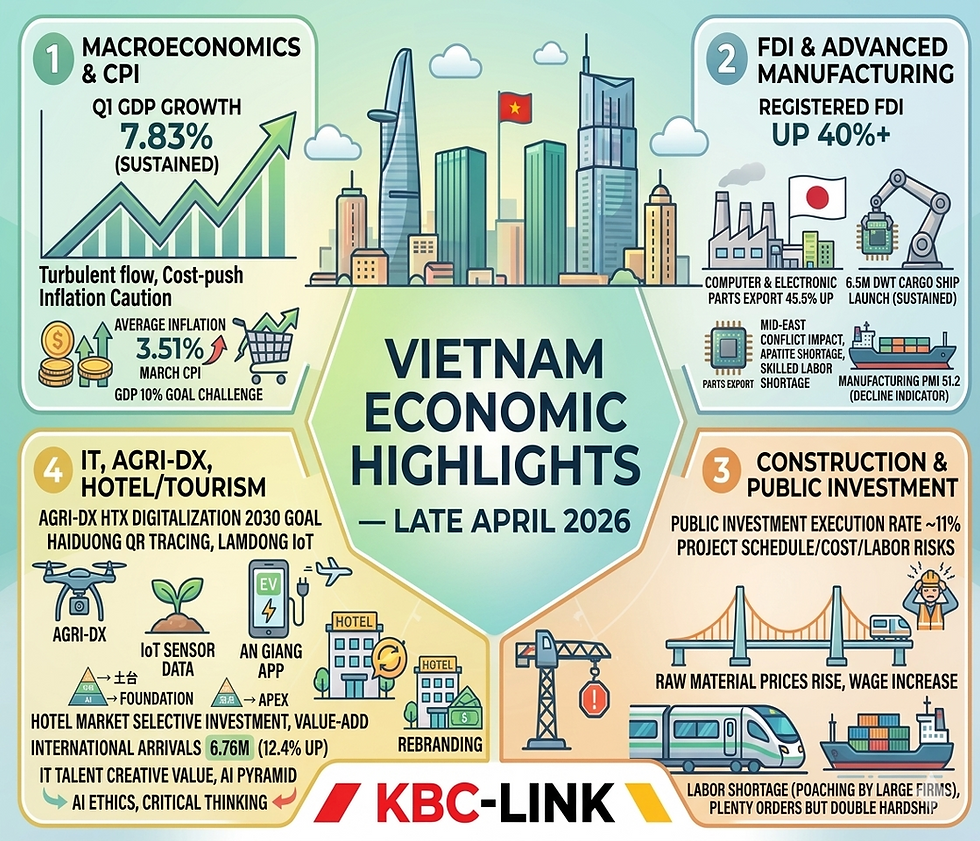
🇻🇳 Vietnam Economic Highlights (Early May) | KBC-LINK
Vietnam's economy continues to press ahead with structural transformation, driven by accelerating high-tech investment and resilient domestic demand — even as external geopolitical pressures mount. FDI disbursement for January–April reached its highest level in five years, and Intel's transfer of chip manufacturing equipment signals Vietnam's growing ambition as a semiconductor hub. Coffee exports held firm at USD 3.6 billion, underscoring the continued strength of the agricultural sector.
At the same time, headwinds are building. April's manufacturing PMI slipped to 50.5 as Middle East tensions pushed up costs across the supply chain. The construction sector, buoyed by infrastructure mega-projects, is grappling with a worsening shortage of skilled workers that is driving up wages and threatening project timelines. On the tourism front, Ho Chi Minh City posted USD 6.5 billion in tourism revenue in just four months — while the Ministry of Public Security simultaneously announced tighter oversight of foreign nationals. Market expansion and compliance tightening are now advancing in parallel. For foreign companies, the operating environment calls for localized supply chains and scenario planning that accounts for both labor and regulatory risk.

📌 Also recommended: Vietnam Economic Highlights — Late April 2026
Vietnam Industry Watch: Key Sectors to Watch

Vietnam Economy (General)
FDI Disbursement Hits Five-Year High for January–April, Led by Manufacturing
According to the latest data from Vietnam's Ministry of Planning and Investment, realized foreign direct investment for January–April 2026 grew 9.8% year-on-year to USD 7.40 billion — the highest amount recorded for the first four months of the year over the past five years. The processing and manufacturing sector accounted for USD 6.12 billion, or 82.7% of total disbursed FDI, reaffirming Vietnam's position as a preferred destination for supply chain relocation.
On the newly registered side, 1,249 projects were approved with a combined registered capital of USD 12.15 billion — a 2.2-fold increase in capital terms compared to the same period last year. By country of origin, Singapore led with 49.8% of total newly registered capital, followed by South Korea (33.6%) and China (4.3%). Geographically, Thai Nguyen Province and Ho Chi Minh City attracted the largest concentrations of new investment.
Source: Trading Economics, May 3, 2026
The accelerating pace of FDI inflows — particularly the concentration in manufacturing — is intensifying competition for industrial land, clean energy supply, and engineering talent in key industrial zones. Companies evaluating Vietnam as a production or sourcing base should move early on site selection and conduct thorough local benchmarking on compensation and benefits. A market that is this active rewards preparation.
Construction and Infrastructure
Skilled Labor Shortage Reaches Critical Levels as Q2 Construction Demand Surges
According to ManpowerGroup Vietnam's "Vietnam Construction Workforce Trends 2026" report, the construction sector has become the most competitive segment of the country's labor market. The Net Employment Outlook (NEO) for Q2 2026 stands at 64%, with 75% of construction companies indicating plans to expand their workforce. The demand spike is being driven by the convergence of FDI-linked factory construction and landmark infrastructure projects — including the North–South Expressway and Long Thanh International Airport.
Against this backdrop, the shortage of skilled professionals with specialized capabilities — including BIM (Building Information Modeling) and green building certifications — has reached a breaking point. Poaching activity is driving up wages rapidly, and the resulting cost pressure is translating directly into project delay risk for mid-sized contractors.
Source: ManpowerGroup Vietnam, May 12, 2026
For companies entering Vietnam through construction, infrastructure, or real estate-adjacent businesses, separate risk assessments for costs, timelines, and workforce availability are essential — not optional. Fixed-price contracts in particular should include explicit material cost escalation clauses. Assuming that a favorable project pipeline translates directly into predictable profitability would be a costly mistake in the current environment.
Manufacturing
April Manufacturing PMI Falls to 50.5 — Geopolitical Cost Pressures Hit Demand
The S&P Global Vietnam Manufacturing Purchasing Managers' Index (PMI) for April 2026, released on May 4, fell to 50.5 from 51.2 in March — the lowest reading in seven months. While the index remained above the 50-point expansion threshold for the twelfth consecutive month, the pace of growth in both new orders and output slowed sharply.
The primary drivers were rising fuel and oil prices linked to escalating Middle East tensions, compounded by surging global maritime freight costs. Input prices climbed at the fastest pace in 15 years, forcing manufacturers to pass costs through to selling prices. As a result, new orders — particularly export orders — contracted for the first time in eight months, and business sentiment among manufacturers fell to its lowest level in seven months.
Source: S&P Global / Trading Economics, May 4, 2026
Vietnam's manufacturing sector remains in expansion territory, but is increasingly exposed to external geopolitical shocks and logistics cost volatility. Companies entering the market should prioritize building supply chain models that are resilient to freight cost fluctuations — specifically by increasing the localization ratio of inputs and reducing dependence on long-haul import logistics wherever feasible.
Agriculture
Vietnam Maintains World No. 2 Coffee Producer Status; January–April Exports Reach USD 3.6 Billion
According to the latest data from the U.S. Department of Agriculture (USDA) and Vietnam's Ministry of Agriculture and Rural Development, Vietnam is on track to cement its position as the world's second-largest coffee producer and the largest global supplier of Robusta beans in the 2025/26 crop year. Favorable weather and increased investment in plantations are expected to drive production to 30.8 million bags (60 kg each), marking a recovery from the previous season.
Coffee exports for January–April 2026 reached USD 3.6 billion, making coffee Vietnam's top-earning agricultural export category for the period. April alone saw export volumes of 198,000 tons, up 15% year-on-year. While average export prices have softened year-on-year due to global supply concerns, Vietnamese Robusta continues to hold a dominant position in the instant coffee and commercial blending markets worldwide.
Note: Japanese yen equivalents have been omitted from this edition pending confirmation of the applicable exchange rate.
Source: Asia News Network, May 15, 2026
Vietnam's coffee industry is shifting from volume-based production toward value-added processing — a transition driven by global demand for Robusta and growing domestic processing capacity. For companies with capabilities in roasting, instant coffee manufacturing, or brand development, the business environment for establishing local processing operations or partnering with existing producers is highly favorable.
Technology & IT Talent
Vietnam's National Semiconductor Lab Advances as Intel Transfers Chip Assembly Equipment to Hanoi
Vietnam National University Hanoi (VNU) is accelerating the development of its USD 70 million National Semiconductor Laboratory. As a landmark step in this initiative, Intel and its local subsidiary (IPV) have transferred a full set of commercial-grade chip assembly and testing equipment — used in back-end semiconductor manufacturing — to VNU and Saigon Hi-Tech Park (SHTP). This marks the first time Intel has repurposed active commercial manufacturing equipment for educational and research use in Vietnam.
The initiative is directly aligned with the Vietnamese government's national target of training 50,000 semiconductor engineers. VNU will use the equipment to build advanced hands-on training capacity in chip packaging, testing, and IC design. The broader ecosystem is expanding rapidly: the number of IC design firms in Vietnam has grown from 40 to 60 over the past two years, while back-end manufacturing and assembly companies have increased from 7 to 15.
Source: TechNode Global, May 13, 2026
Intel's equipment transfer is a concrete signal — not just a policy statement — that Vietnam is transitioning from a low-cost labor destination to a high-technology manufacturing hub. As the talent pipeline matures, the window for early-mover advantage is open for companies in semiconductor design, advanced components, and manufacturing equipment. Establishing local partnerships or research linkages with VNU now positions companies ahead of the curve.
Hotel & Tourism Investment
6-1. Ho Chi Minh City Tourism Revenue Tops USD 6.5 Billion in First Four Months — Over 52% of Annual Target Achieved
Ho Chi Minh City recorded strong tourism growth in the first four months of 2026, generating more than VND 172 trillion (approximately USD 6.5 billion) in tourism revenue — fulfilling over 52% of the city's full-year target ahead of schedule. International arrivals to the city during the period were estimated at 4.78 million, while domestic tourist numbers reached approximately 19.2 million.
During the extended holiday period from April 25 to May 3 — covering the Hung Kings Commemoration Day, Reunification Day, and International Workers' Day — the city welcomed an estimated 190,000 international visitors and 1.5 million domestic travelers, generating approximately VND 8.7 trillion (USD 330 million) in revenue. The city launched nearly 1,000 new tourism products and services during the period, with nighttime tourism offerings (including the Cu Chi Tunnels night tour and Cho Lon Night Tour) and MICE tourism performing strongly.
Source: Tuoi Tre News, May 9, 2026
Ho Chi Minh City's tourism market is in a clear expansion phase, with both volume and product quality moving in the right direction. For companies considering entry into hospitality, food and beverage, MICE, or nighttime economy segments, demand-side conditions are favorable. A pace of 52% of the annual target fulfilled in just four months strongly suggests full-year performance will significantly exceed the original target — making this a compelling data point for new investment decisions.
6-2. As Tourist Arrivals Surge, Ministry of Public Security Announces Tighter Oversight of Foreign Nationals — Compliance Risk Increases
Against the backdrop of record tourist arrivals, Vietnam's Deputy Minister of Public Security, Pham The Tung, announced on May 15 at a conference in Ho Chi Minh City that the government will strengthen management and monitoring measures for foreign nationals residing in and traveling through Vietnam. The country received a record 22.8 million international visitors in 2025 (up approximately 18% year-on-year), and has already welcomed more than 9 million in the first months of 2026 — a 22.5% increase compared to the same period last year.
The government stated its intention to maintain open visa policies to support tourism and investment, while warning that a growing number of foreign nationals are exploiting these policies for illegal employment, overstay violations, and other unlawful activities — creating national security concerns. Going forward, police organizations nationwide — particularly community-level district and ward police — will intensify monitoring of accommodation facilities including hotels and short-term rentals, and will strengthen coordination on entry and exit data.
Source: Qazinform / VNA, May 17, 2026
While Vietnam's visa regime continues to trend toward openness, operational compliance requirements for foreign nationals on the ground are tightening considerably. Foreign companies should treat this as a signal to review and tighten internal compliance procedures across three specific areas. First, work permit and business visa expiration tracking and renewal workflows. Second, guest registration obligations for foreign staff and customers using hotels, condominiums, and short-term rental accommodation. Third, operational readiness for unannounced on-site checks by district and ward-level police. The risk of penalties for procedural non-compliance is meaningfully higher than it was previously. Early engagement with a qualified local legal and HR compliance advisor is strongly recommended.
KBC-LINK Editorial Perspective
Vietnam's economy is in a period of qualitative transformation. The high-tech ambitions are real — semiconductor infrastructure is being built, FDI is flowing in at record pace, and the talent pipeline is gradually maturing. But the "growth distortions" are equally real: global cost pressures are squeezing manufacturers, skilled labor shortages are straining the construction sector, and the regulatory environment for foreign nationals is tightening.
The operating premise that made Vietnam attractive as a "low-cost destination" is not wrong — but it is increasingly insufficient as a standalone strategy. Companies that will succeed in the next phase are those that build supply chains resilient to geopolitical shocks, invest consistently in local talent relationships, and approach compliance not as a checkbox but as a structural advantage.
KBC-LINK will continue to provide ground-level insight designed to bridge the gap between Vietnam's headline narrative and operational reality.
Edited & Summarized by:
KBC-LINK Editorial Team (compiled with independent perspectives and on-the-ground insights).