

🇻🇳 Vietnam Economic Highlights (Late April) | KBC-LINK
Updated: May 7
This report curates the most important Vietnam-related economic news from late April 2026, selected specifically for small and mid-sized foreign businesses and investors who are actively monitoring or considering entry into the Vietnamese market.
Note: Editorial comments at the end of each topic are insights and analysis prepared by the KBC-LINK editorial team, based on publicly available information..
If one theme defines Vietnam's economic news in late April, it is this: strong ambition, uneven execution. Headline macroeconomic figures — GDP growth, FDI inflows, tourist arrivals — remain robust. Yet on the ground, delayed public investment disbursement, a construction sector caught in a cost-and-labor squeeze, and persistent bottlenecks in manufacturing all point to a widening gap between strategic intent and operational capacity.
At the same time, meaningful structural shifts are underway. Agricultural digitalization, the rethinking of IT talent development, and a more discerning hotel investment market all signal that Vietnam's economy is not just growing — it is gradually changing in character. For companies considering market entry, the ability to read both the headline numbers and the ground-level friction is more important than ever.
📌 Also recommended: Vietnam Economic Highlights — Early April 2026
Vietnam Industry Watch: Key Sectors to Watch

Vietnam Economy (General)
Vietnam's Growth Ambitions Meet Structural Headwinds
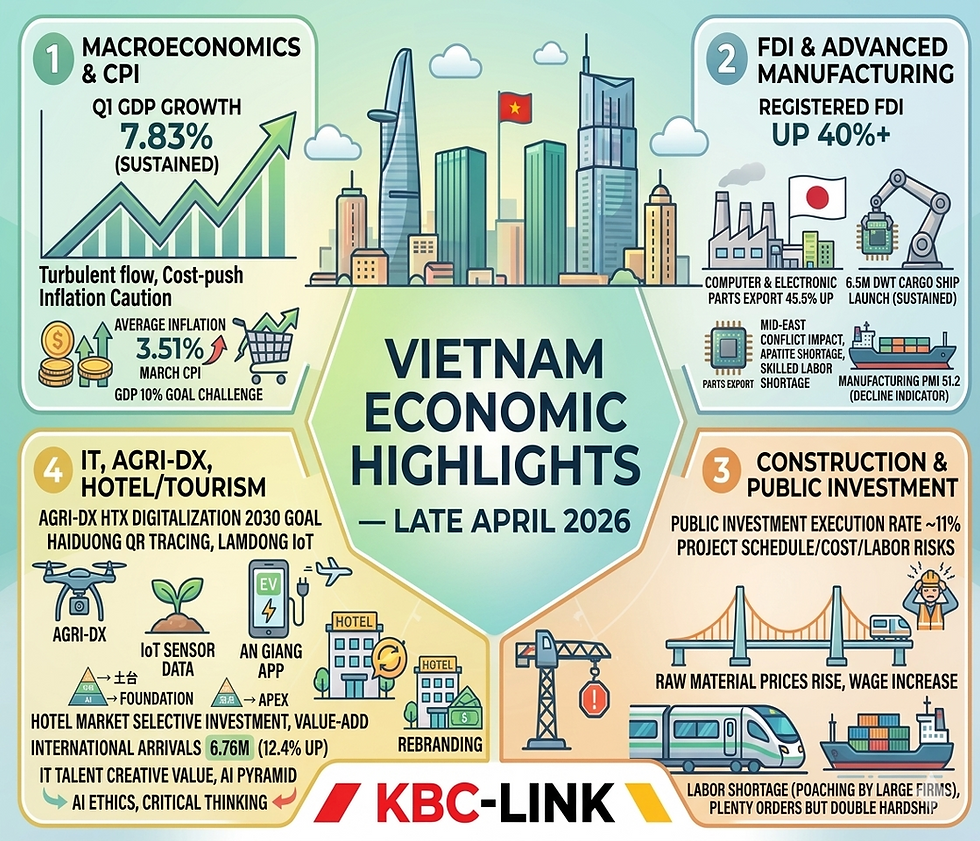
Vietnam's economy posted GDP growth of 7.83% in Q1 2026, maintaining the momentum needed to pursue the government's ambitious full-year target of 10%. Average inflation held at 3.51%, but March's month-on-month CPI surged to 4.65% — a level that warrants serious attention as a sign of cost-push inflationary pressure.
On the positive side, registered FDI rose more than 40% year-on-year, reflecting continued confidence from international investors. However, public investment disbursement reached only approximately 11% of the annual plan by end of Q1 — a persistent structural problem where capital moves quickly on paper but slowly in the field. Root causes include unresolved land clearance issues, inconsistent material supply chains, layered administrative procedures, and — critically — a bureaucratic culture that prioritizes avoiding mistakes over taking initiative.
Source: TuoiTre Online, April 28, 2026
Vietnam is navigating what one analyst describes as a period of "turbulence" — high growth ambition paired with structural execution gaps. Companies considering market entry should resist anchoring their business plans to optimistic macro indicators alone. Build in realistic buffers for procedural delays, cost escalation, and slower-than-expected approvals at the local level. A conservative, flexible plan will consistently outperform an optimistic, rigid one in this environment.
Construction and Infrastructure
A Sector Under Pressure: Rising Costs Meet a Shrinking Workforce
Vietnam's construction industry is grappling with a double crisis in 2026. A robust pipeline of public infrastructure projects and growing real estate demand means there is no shortage of work. But surging raw material prices and logistics disruptions have created a painful dilemma for contractors: continuing a project means operating at a loss, while halting it risks breach of contract.
Compounding the cost pressures is a worsening labor shortage. Workers are increasingly migrating to higher-paying sectors or being poached by larger developers, driving up wages and threatening the viability of small and mid-sized contractors.
Source: VnEconomy, April 22, 2026
For companies entering Vietnam through construction, infrastructure, or real estate-adjacent businesses, separate risk assessments for costs, timelines, and workforce availability are essential — not optional. Fixed-price contracts in particular should include explicit material cost escalation clauses. Assuming that a favorable project pipeline translates directly into predictable profitability would be a costly mistake in the current environment.
Manufacturing
Strong Headline Growth, Persistent Ground-Level Bottlenecks
Strong Headline Growth, Persistent Ground-Level Bottlenecks
Vietnam's manufacturing and processing sector grew 11.1% year-on-year in Q1 2026, continuing its role as the primary engine of economic expansion. Metal production rose 20.13% and non-metallic mineral products grew 22.28%, driven largely by public infrastructure investment. Computer and components exports surged 45.5%, and the domestic shipbuilding industry achieved a milestone with the launch of its largest domestically designed vessel to date — a 65,000 DWT cargo ship.
However, the headline figures mask significant stress below the surface. Middle East tensions are pushing up energy and input costs, compressing margins. The manufacturing PMI eased to 51.2 in March. Shortages of apatite (a key industrial raw material) and qualified skilled labor are creating production bottlenecks in several provinces. The government has approved a new "Strategic Industries Law" aimed at strengthening upstream supply chains and increasing domestic value-added content.
Sources: Báo Đầu tư Chứng khoán, April 22, 2026; Tạp chí Công Thương, April 29, 2026; Lao Động, April 28, 2026; Quân đội nhân dân, April 28, 2026
For companies evaluating manufacturing partnerships or direct investment in Vietnam, the strong aggregate numbers should not obscure the need for granular due diligence. Supply chain diversification and access to qualified technical labor are the two most critical variables to assess before committing. "High growth" at the sector level does not automatically translate to predictable operational performance at the plant level.
Agriculture
Vietnam's Farming Sector Enters a Digital Inflection Point
Vietnam's agricultural sector is undergoing a significant structural transition in 2026, driven by a nationwide push for digital transformation (DX). For the country's more than 19,000 active agricultural cooperatives (HTX), adopting technology to adapt to climate change and sharpen international competitiveness has shifted from being a strategic option to a survival requirement.
Concrete results are beginning to emerge across provinces. Hai Duong Province has implemented QR code-based supply chain tracking; Lam Dong Province is using IoT sensors for resource management; An Giang Province has connected farmers to real-time market data and policy updates through mobile applications, supporting local brand-building efforts. The government has set a target for full electronic data integration across all cooperatives by 2030, though rural broadband infrastructure gaps and a shortage of agricultural IT talent remain significant hurdles.
Source: Ministry of Science and Technology Communications Center, April 22, 2026
Vietnam's agricultural sector is moving — unevenly but unmistakably — from labor-intensive production toward data-driven operations. For companies with capabilities in agricultural IoT, traceability systems, or agri-tech solutions, government policy is now actively creating market demand. The window for early-mover advantage in this segment is open.
Technology & IT Talent
Beyond Code: What Vietnam's Next Generation of IT Professionals Is Being Trained to Do
As AI tools increasingly automate coding and testing workflows, Vietnamese IT educators are actively rethinking what it means to prepare students for the workforce. The emerging framework centers on a three-tier capability model:
Foundation: Deep understanding of algorithms, data structures, and computer architecture — the fundamentals that AI cannot reason around.
Middle layer: Practical AI fluency, including prompt engineering and working effectively with large language model tools.
Peak: Skills that AI cannot readily replicate — design thinking, AI ethics, cross-disciplinary problem-solving, and the ability to critically evaluate AI-generated outputs rather than simply accepting them.
The shift in framing is notable: students are being encouraged to see themselves not just as creators of software, but as informed evaluators — capable of auditing what AI produces. Familiarity with applied concepts such as LLM Ops and retrieval-augmented generation (RAG) is increasingly part of the curriculum.
Source: Báo Giáo dục và Thời đại, April 26, 2026
Foreign companies hiring Vietnamese IT talent should update their evaluation criteria accordingly. Coding speed and technical proficiency remain important, but the more differentiating question is: Can this candidate explain why they chose a particular solution? Engineers who over-rely on AI tools without understanding their limitations will struggle when non-standard problems arise. Consider packaging structured AI-literacy training into your onboarding program — and position your workplace as one where engineers exercise genuine creative judgment, not just tool operation. Vietnam should increasingly be viewed as a potential DX enablement hub, not simply a cost-arbitrage destination.
Hotel & Tourism Investment
From Volume to Value: Vietnam's Hotel Market Enters a Selective Investment Phase
Vietnam's hotel investment market is undergoing a qualitative shift — moving from broad-based expansion toward selective, value-driven asset acquisition. A recently completed transaction valued at approximately USD 53.7 million has reignited investor interest from both domestic and international buyers. Domestic investors are showing a preference for long-term asset holds with active repositioning, while foreign investors are applying increasingly rigorous standards around location quality and international operational benchmarks. Total hotel investment for 2026 is projected to reach USD 200 million.
Underpinning this investment activity is strong fundamentals: international arrivals in Q1 2026 reached 6.76 million, a 12.4% increase year-on-year, signaling robust and sustained recovery in tourism demand.
Source: VnEconomy, April 29, 2026
For companies considering entry into Vietnam's hospitality, real estate, or tourism-adjacent sectors, three strategic considerations stand out. First, the market has moved beyond simple asset acquisition toward value creation through repositioning — post-purchase rebranding, operational improvement, and customer experience enhancement are now the primary drivers of investment returns. Second, hotel land in Vietnam is classified as commercial-service land, typically structured as leasehold rather than freehold. Foreign companies may hold 100% ownership stakes, but lease duration and legal structure directly affect asset valuation. Rigorous legal due diligence at the outset is non-negotiable. Third, the most successful model currently involves complementary local-foreign partnerships — pairing domestic investors who bring market knowledge and regulatory relationships with international operators who bring management standards and global networks. A joint approach consistently outperforms solo market entry in terms of both speed-to-operation and long-term efficiency.
KBC-LINK Editorial Perspective
Across all six topics this month, a single underlying theme emerges: Vietnam is determined to transform, but the pace of transformation is uneven.
Macro indicators — GDP growth, FDI, arrivals, manufacturing output — continue to paint an encouraging picture. But public investment execution delays, construction sector stress, and manufacturing bottlenecks all point to the same friction point: the system's operational capacity has not yet caught up with its strategic ambitions.
For foreign small and mid-sized businesses, this gap is not just a risk — it is also where opportunity lives. Companies that can navigate procedural complexity, invest patiently in local talent, and build genuine complementary partnerships with Vietnamese counterparts will find themselves well-positioned as the market matures.
KBC-LINK will continue to provide ground-level insight designed to bridge the gap between Vietnam's headline narrative and operational reality.
Edited & Summarized by:
KBC-LINK Editorial Team (compiled with independent perspectives and on-the-ground insights).


